Spacio
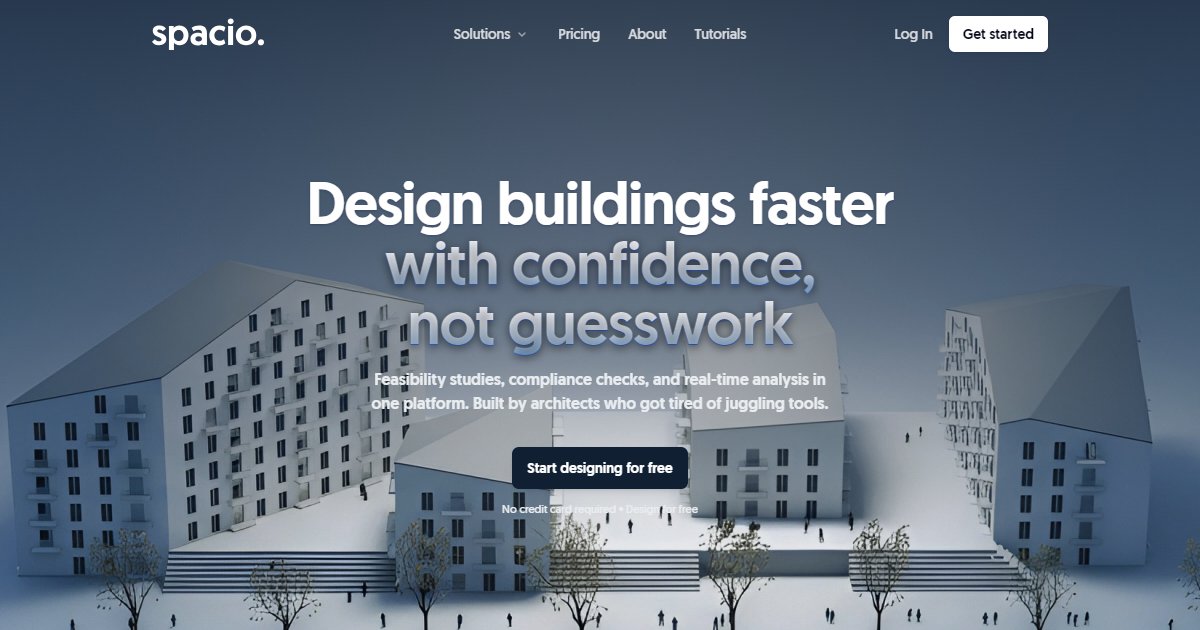
Spacio is a browser-based early-phase design platform for residential feasibility work that combines parametric massing, live code-oriented checks, simulations such as daylight and sun hours, and BIM-structured export paths toward Revit, Archicad, Rhino, and IFC.

Spacio targets architects and developers who need defendable early schemes without standing up a full authoring environment first. You pick a location, work from generated terrain and context, then iterate on building geometry while metrics and compliance-style feedback update in the same session.
On its FAQ pages, Spacio states customers report about an 80% reduction in iteration time during feasibility and a move from roughly three weeks to roughly three days for comparable work, tied to faster site setup, parametric edits, live validation, and drawing automation (Spacio FAQ, 2025). Treat any aggregate figure as directional until you benchmark on your own projects.
Code coverage called out publicly centers on BBR in Sweden and TEK17 in Norway today, with Danish and German rules described as on the way, plus zoning-style checks alongside those frameworks (Spacio FAQ, 2025). Automatic permit drawings and deeper compliance modules appear with beta labeling in marketing copy, so procurement teams should confirm scope for each country release.
Pricing runs from a limited free tier through personal Starter and Pro plans and an organisation Business tier with floating licenses. The about page traces the product to a Norwegian team that shipped earlier analysis tools before consolidating into Spacio (Spacio about page, 2025). Integrations called out on-site include Rhino, IFC, DXF, OBJ, Excel, and dotBIM among others on the homepage tiles.
Specifications
Pricing
Platforms
Used for
Used by
Tasks
Pros and cons
Pros
- Clear tiered pricing with a free entry point and published euro rates for personal plans.
- Strong Nordic reference codes named explicitly for buyers who need BBR or TEK17 alignment.
- About page and timeline give credible background on founders and prior analysis products.
- Comparison content on Why Spacio explains where it sits versus general 3D and BIM tools for early phases.
Cons
- Several advanced items ship under beta badges on the homepage, so contracts should list which modules you rely on.
- Free and lower tiers cap projects, terrain extent, and exports; export day passes appear as separate fees on the pricing grid.
- Building rule depth varies by country; teams outside the published Nordic set should validate locally before promises to authorities.
- Heavy detail documentation still lands in Revit or Archicad; Spacio is positioned as upstream, not a full CD replacement.
Key features
Browser-first workflow: Run feasibility sessions without installing desktop BIM suites; the web app targets laptops common in design reviews.
Site and zoning context: Marketing claims geo-located terrain, surroundings, and zoning-style inputs from a location search worldwide.
Live metrics: Gross floor area, net internal area, efficiency, parking, and unit-mix style KPIs update while you edit schemes.
Simulation inside design: Daylight, sun hours, and view studies are positioned as real-time rather than overnight consultant loops.
Compliance-oriented checks: Height, setbacks, fire routes, parking, and corridor questions appear in product messaging with Nordic rules called out explicitly.
Export paths: IFC-oriented BIM exports plus spreadsheet and mesh formats appear in integration lists; Revit and Archicad handoffs are described for downstream documentation.
Team modes: Business pricing advertises floating licenses and organisation-owned projects compared with personal plans.
Pricing
Free
Contact sales
Limited saves per session, three projects, basic terrain; verify limits on spacio.ai/pricing.
Starter (billed yearly)
per year (12 mo)
€250.00
Listed as 250 per year on spacio.ai/pricing; about21 per month when billed annually. Verify before checkout.
Pro (billed yearly)
per year (12 mo)
€948.00
Listed as 948 per year; about79 per month when billed annually. Includes all file exports on the grid reviewed in 2026.
Business (from, yearly)
per year (12 mo)
€3,995.00
Starting at ???3995 per year with two floating users on the public page; contact sales for quotes.
Frequently asked questions
How much does Spacio cost in euros per year?
As of the public pricing page, Starter bills at 250 per year (shown as about21 per month billed yearly), Pro at 948 per year (about79 per month billed yearly), and Business starts at ???3995 per year with two floating users included. A limited Free tier exists with project and save caps. Confirm numbers at spacio.ai/pricing before purchase because currency and tax can change.
Does Spacio replace Revit or Archicad?
Spacio???s own FAQ positions it for feasibility through planning permission, then export to Revit or Archicad for detailed design. It is framed as an early-phase companion, not a full documentation replacement.
Which building codes does Spacio check today?
The FAQ names BBR for Sweden and TEK17 for Norway, with Danish and German rules described as coming later, plus zoning validation that updates over time. Always confirm the exact rule packs activated for your account region.
What file formats can Spacio import and export?
Homepage integration tiles reference IFC, DXF, Rhino, OBJ, Excel, and dotBIM among others, with higher tiers unlocking broader import and export according to the pricing table. Ask support for the precise format revision you need for your BIM execution plan.
Can students use Spacio for free?
Spacio advertises a dedicated student program and free licences for educational institutions on its pricing and student pages. Use the student route linked from the main navigation rather than assuming a classroom licence without paperwork.
How does Spacio handle collaboration?
Marketing copy describes simultaneous work on one project without file versioning conflicts, while Business plans add organisation-owned projects and floating licenses for concurrent seats. Validate SSO and admin controls with sales if you need enterprise governance.
Tutorials and learning
Sources
Other Design tools
- spacivFreemium
spaciv is a web-based workplace and real estate analytics platform that ties organizational and building data to space demand, carbon
- SynapsFreemium
Synaps is a browser-based architectural design canvas that combines AI-assisted drafting, floor plan tracing, asset libraries, and
- Vectorworks ArchitectPaid (trial)
Vectorworks Architect is a cross-platform BIM authoring application from Vectorworks, Inc. that combines 2D drafting, Parasolid-based 3D
- WASPPaid
WASP is an Italian manufacturer of large-format 3D printers that includes dedicated construction lines such as Crane WASP and concrete LDM
- Zawia AI by ConixEnterprise quote
Zawia AI by Conix is a web-based generative architecture service for Saudi villa projects that combines map-based site input, AI-generated
- ZeneratePaid (contact)
Zenerate is a web-based land-development feasibility application that pairs AI-generated site plans and floor plans with editable layouts,
- ZURU TechEnterprise quote
ZURU Tech is a design-to-production platform for configurable houses that pairs browser-based layout and finishes choices with digitally
- Agile FormSubscription
Agile Form sells desktop plugins for Autodesk Revit, SketchUp, and AutoCAD that automate sun and shadow studies, sun exposure checks, and