Slabstack
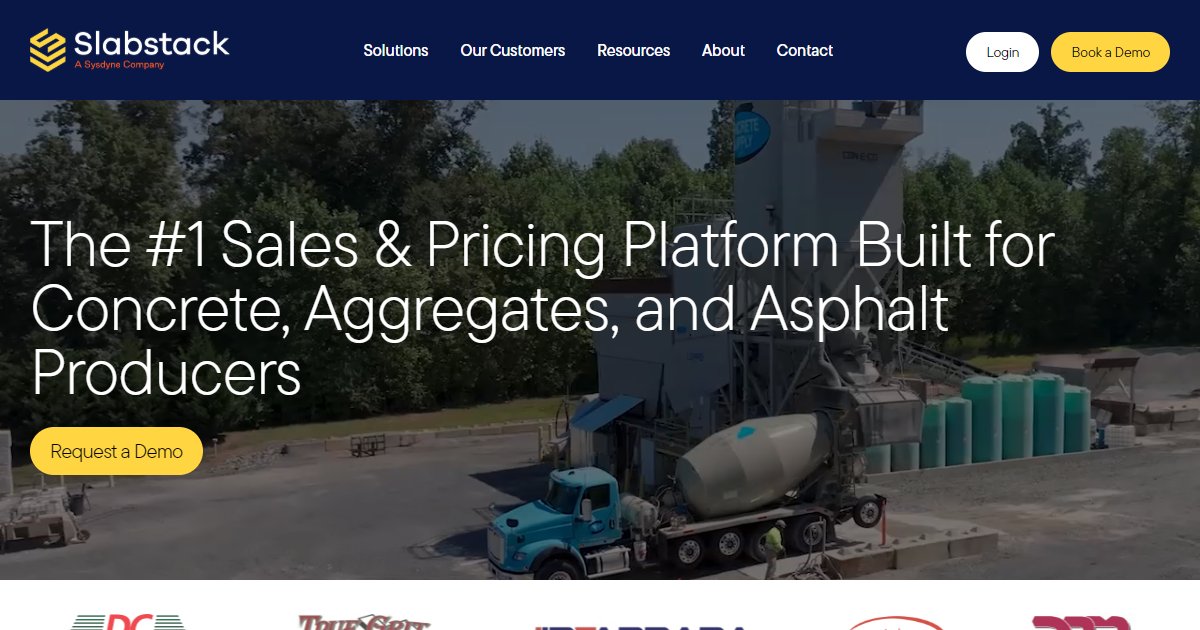
Slabstack is a CRM and sales intelligence platform built for ready-mix concrete, aggregate, and asphalt producers that ties quoting, dispatch-aware pricing, and backlog views together so sales teams protect margins on volumetric and hauling-heavy orders.

Materials producers juggle customer-specific pricing, haul zones, and plant capacity while sales staff still work from spreadsheets and email. Slabstack markets a single workspace for quotes, orders, and analytics aimed at concrete, aggregate, and asphalt operations rather than generic CRMs.
The homepage claims more than 100 producer locations use Slabstack and cites customer-reported outcomes such as up to roughly 50% higher profitability, payback near 60 days, and about 90% less manual work in quoting, alongside unified backlog views across quotes, shipments, and risk (Slabstack marketing site, 2026). Treat those figures as directional until you validate in your own pilot.
Feature areas include dynamic pricing tied to dispatch data, templates that pull customer and pricing context automatically, two-way integration with dispatch systems to reduce order errors, forecasting and BI views, CRM-style customer history, and backlog reporting that merges quote, forecast, and production signals.
Slabstack is North America oriented in customer logos and phone contact. Teams outside that region should ask about units, tax, language, and integration partners before signing.
Specifications
Pricing
Platforms
Used for
Used by
Tasks
Pros and cons
Pros
- Purpose-built vocabulary for tons, yards, plants, and hauling fits materials producers better than horizontal CRMs.
- Customer stories on the site reference real producer names and roles.
- Connects commercial workflows to dispatch, which is where many quoting errors surface.
Cons
- No transparent public price list; expect demos and enterprise sales.
- Not a BIM model server; it supports commercial operations for materials, not design authoring.
- ROI statistics are vendor-sourced and need confirmation in your environment.
Key features
Quoting and templates: Centralize customer and pricing data so reps spend less time retyping bids.
Dispatch integration: Two-way flow between sales quotes and dispatch systems to cut translation errors into orders.
Backlog visibility: Combine quote, forecast, and production signals to see what is sold, shipping, and at risk.
BI and forecasting: Trend views to support investment and pricing decisions.
Industry focus: Separate solution pages for ready mix, aggregates, and asphalt producers.
Pricing
Enterprise (demo)
Contact sales
Contact Slabstack for pricing; no public list on slabstack.com as of 2026-04-03.
Frequently asked questions
Is Slabstack a BIM tool?
No. It targets sales, quoting, and dispatch integration for concrete and related materials producers. Design teams would keep using their BIM and estimating tools upstream.
Which dispatch systems does Slabstack integrate with?
Marketing copy references integration with dispatch platforms but does not list every vendor by name in the pages reviewed. Ask Slabstack for your specific dispatch and ERP stack during discovery.
Who uses Slabstack?
Case studies name ready-mix and aggregate producers in North America. Roles highlighted include sales managers, vice presidents, and plant leadership.
How much does Slabstack cost?
The public site routes prospects to request a demo rather than listing per-seat prices. Budget as enterprise SaaS with implementation services.
Does Slabstack work for asphalt plants?
Yes, the vendor publishes an asphalt producer solution page alongside ready mix and aggregates.
What alternatives compete with Slabstack?
Teams often compare dedicated materials CRM and pricing tools against horizontal CRMs or custom spreadsheets. Evaluate integration depth to dispatch and how well pricing rules express haul and mix logic.
Tutorials and learning
Sources
Other Cost Management tools
- Smartapp.comSubscription
Smartapp.com is a subscription construction operations platform that combines planning, field collaboration, project controls, and safety
- Trimble ViewpointEnterprise quote
Trimble Viewpoint is a construction ERP and project management suite from Trimble that ties accounting, payroll, HR, job costing, and field
- AgaveEnterprise quote
Agave is a web platform for construction contractors that syncs project and ERP data, then applies AI to accounts-payable intake, coding,
- AlascoEnterprise quote
Alasco is a cloud financial platform for real estate developers and asset teams that unifies budgeting, live cost control, financing
- Beam by TrybeamFreemium
Beam by Trybeam is cloud-based construction finance and operations software for small and midsized contractors that combines AI-assisted
- BEXEL ManagerEnterprise quote
BEXEL Manager is a Windows-based openBIM suite for 4D and 5D construction planning that links model elements to schedules, costs,
- Bid Management by ProcoreEnterprise quote
Bid Management by Procore is a preconstruction bidding suite that centralizes invitations, leveling, trade partner qualification, and
- BQE COREEnterprise quote
BQE CORE is a cloud operations suite for architecture and engineering firms that unifies time and expense capture, billing, project