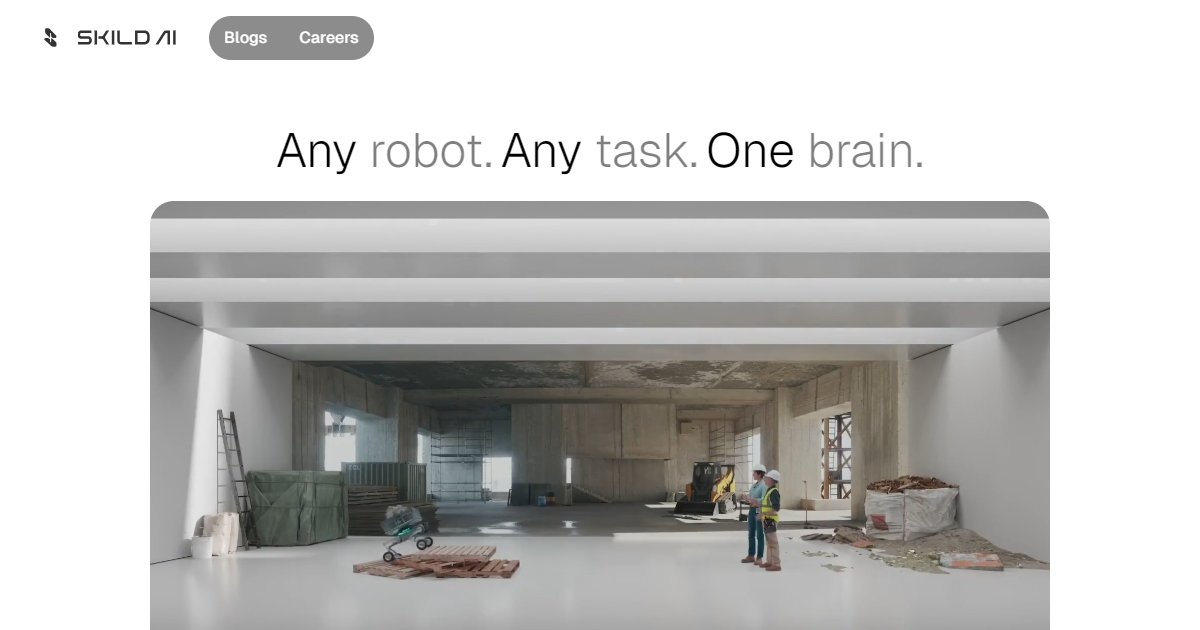
Skild Brain
Skild Brain is Skild AI's embodied AI stack pitched as one brain for many robot types, combining navigation and manipulation skills for inspection, mobile platforms, and packing workflows while emphasizing learning from human video with limited new robot time.

Skild AI markets Skild Brain as a unified, omni-bodied policy layer that should not be tied to a single hardware line. Public pages outline three application tracks: robots that inspect unstructured or hazardous spaces without constant human patrols, mobile manipulators that expose grasping and navigation through an API so application teams avoid hand-writing low-level controllers, and packing lines that need repeatable fine motor skills.
A January 2026 company article on learning from video states that, after bridging embodiment gaps between people and machines, Skild fine-tunes new skills from demonstrations with under about one hour of supplementary robot data in their reported setup, positioning video as a way past pure teleoperation limits (Skild AI, 2026). That article also explains why the team sees teleoperation alone as hard to scale for diversity and wall-clock throughput.
The homepage lists funding partners without public dollar amounts or SKU-level pricing, so commercial terms, safety certification scope, and supported OEM integrations should be confirmed directly with Skild. The writing style targets robotics platform builders and enterprise automation groups rather than casual users.
Because the field moves quickly, treat marketing claims about generalization as hypotheses to validate on your robots, environments, and compliance rules before locking a production architecture.
Specifications
Pricing
Platforms
Used for
Used by
Tasks
Pros and cons
Pros
- Clear product pillars (inspection, mobile manipulation, packing) map cleanly to common enterprise automation conversations.
- Public blog gives dated technical narrative on data scaling, which helps buyers benchmark vendor thinking.
- API framing for manipulation suits teams that already own middleware and simulation stacks.
Cons
- No public price sheet; procurement needs direct quotes and integration statements of work.
- Video-based learning still depends on embodiment mapping quality; expect trial work on your exact arms and sensors.
- Relative to incumbents with decades of field service, long-term support geography may be narrower; confirm for your regions.
Key features
Inspection and security robots: Messaging focuses on autonomous rounds in messy or risky sites to reduce manual walk-downs.
Mobile manipulation API: Grasp, handover, and navigation are abstracted so higher-level software can call skills without rewriting motion primitives.
Autonomous packing: Describes learning dexterous motions for repetitive packaging tasks.
Video-first learning story: Blog material argues for large human-video corpora paired with small on-robot datasets to grow skill libraries.
Omni-bodied positioning: Materials claim one model direction for multiple robot morphologies rather than one controller per hardware vendor.
Pricing
Enterprise (contact sales)
Contact sales
Public pricing is not listed; obtain a written quote and clarify deployment, training, and support boundaries.
Frequently asked questions
What is Skild Brain?
Skild Brain is Skild AI's name for its robotics foundation software that aims to control varied robots for tasks such as facility inspection, mobile manipulation, and packing. The company describes it as a single brain approach instead of separate stacks per hardware line.
How does Skild say it reduces robotics data collection cost?
A January 2026 Skild article argues that teleoperation alone cannot reach internet-scale diversity, and describes learning new skills from human video with under about one hour of added robot data in their experiments. Your results will depend on cameras, arms, and task complexity.
Is Skild Brain open source?
The public marketing site does not advertise an open-source license for Skild Brain as a whole. Treat it as a commercial platform unless Skild publishes different terms for a specific program.
Which industries does Skild highlight?
Homepage sections call out inspection in dangerous or unstructured environments, logistics-style mobile manipulation, and repetitive packing. Retail or warehouse specifics should be validated in a pilot on your floor layouts.
Does Skild sell robots or only software?
Materials read like a software-and-model layer that runs on customer or partner robots rather than a single branded arm. Ask Skild which hardware partners and reference cells they support today.
Where can I read Skild's technical rationale?
The company hosts blog posts such as the January 2026 piece on learning from human videos, linked from skild.ai, which walks through data scaling arguments and the embodiment gap between people and machines.