nPlan
nPlan is AI project-controls software that trains on a large archive of historical construction schedules so teams can generate programmes, run schedule-risk style forecasts at activity level, and manage portfolio risk in control-room style workspaces.

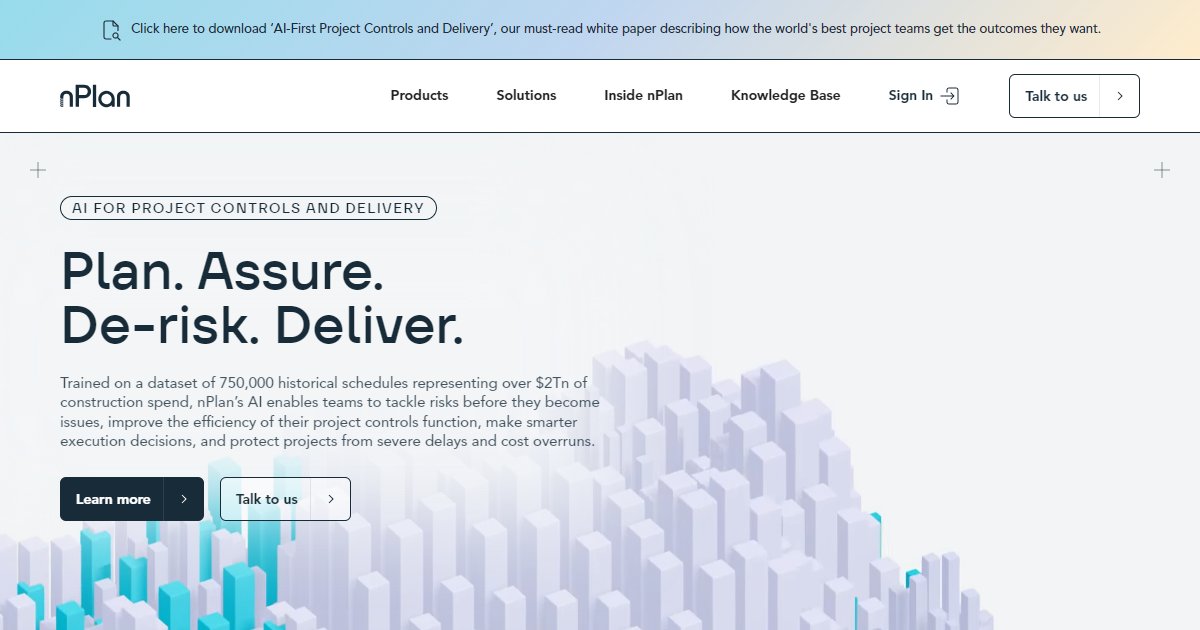
nPlan anchors its models on more than seven hundred and fifty thousand past schedules representing about two trillion dollars of construction spend, then applies that learning to planning, assurance, de-risking, and delivery workflows (nPlan, 2024). The same pages state that over five hundred billion dollars of live work is under active management inside the product, which frames enterprise scale but should be validated in procurement.
Product modules include portfolio oversight, project-level insights, Schedule Studio for generative scheduling, and a schedule integrity checker that hunts logic defects automatically (nPlan, 2024). Use cases span owners and contractors who want activity-level uncertainty forecasts rather than only rolled-up summaries.
The vendor publishes customer quotes from major infrastructure and utilities programmes and runs an academy with short certification-style courses for new users (nPlan, 2024). Blogs contrast traditional risk tooling with nPlan???s AI-driven schedule risk analysis, useful background for evaluation committees.
Pricing is not listed publicly; expect enterprise agreements. Confirm how models ingest Primavera or Microsoft Project files, how data residency is handled, and what human review steps remain mandatory for formal risk reports.
Specifications
Pricing
Platforms
Used for
Used by
Tasks
Pros and cons
Pros
- Strong data story rooted in real historical programmes
- Splits modules for portfolio versus single-project teams
- Integrity checker reduces garbage-in risk before AI runs
- Educational academy helps upskill planners
Cons
- Opaque pricing and heavy enterprise sales motion
- Forecasts are model-dependent; governance is essential
- Requires clean schedule updates to stay trustworthy
- Competitive claims versus traditional QSRA need independent review
Key features
Historical dataset: Trained on a large corpus of real programmes for sector-specific behaviour (nPlan, 2024).
Schedule Studio: Generative drafting and iteration from scope inputs (nPlan, 2024).
Integrity checker: Automated checks for schedule logic issues before forecasts run (nPlan, 2024).
Activity-level assurance: Forecasts uncertainty per activity rather than only high-level summaries (nPlan, 2024).
Portfolio control room: Surfaces systemic themes across many projects (nPlan, 2024).
nPlan Academy: Short courses and certifications for onboarding (nPlan, 2024).
Pricing
Enterprise (contact sales)
Contact sales
No public list pricing; scope modules such as Portfolio, Insights, Schedule Studio, and Integrity Checker.
Frequently asked questions
Does nPlan replace Oracle P6?
It consumes schedules from common tools and returns insights, but P6 or MSP usually remain authoring systems. Clarify import formats and round-trip expectations in a POC (nPlan, 2024).
What is Schedule Studio?
It is the generative module for creating and editing schedules from scope documentation with AI assistance. Pair it with the integrity checker before you baseline results (nPlan, 2024).
How does nPlan differ from classic Monte Carlo add-ins?
Marketing contrasts traditional risk software with AI-driven schedule risk analysis. Ask for methodological whitepapers and back-testing against projects you already closed (nPlan, 2024).
Can owners use nPlan across a capital programme?
The portfolio product targets multi-project oversight with systemic risk themes. Confirm licensing for owner teams versus contractor tenants (nPlan, 2024).
Is training available?
nPlan Academy advertises short courses and certifications tied to employer engagements. Budget time for planners and risk leads to complete them (nPlan, 2024).
Where is data hosted?
The site does not spell out regions on the homepage alone; request the data-processing agreement and map hosting to your owner requirements before uploading confidential programmes (nPlan, 2024).
Tutorials and learning
Sources
Other Scheduling tools
- SitedriveEnterprise quote
Sitedrive is a construction scheduling and site execution platform that keeps phases, locations, and progress in one production-style plan
- SmartPMPaid (trial)
SmartPM is cloud software for commercial construction teams that turns Primavera P6 and Microsoft Project schedules into analytics,
- TactplanEnterprise quote
Tactplan is construction scheduling software that combines location-based scheduling, takt planning, Gantt views, and mobile progress
- ALICEEnterprise quote
ALICE is AI construction scheduling and optioneering software that ingests Primavera or Microsoft Project programmes plus drawings to
- BEXEL ManagerEnterprise quote
BEXEL Manager is a Windows-based openBIM suite for 4D and 5D construction planning that links model elements to schedules, costs,
- BuildertrendEnterprise quote
Buildertrend is a cloud construction management platform for home builders, remodelers, and specialty contractors that combines sales CRM,
- ConstructWisePaid (trial)
ConstructWise is a web-based construction intelligence platform that ingests a contractor's historical bids and schedules so teams can
- DoxelEnterprise quote
Doxel is a computer-vision construction progress platform that ingests BIM from the customer, captures weekly hard-hat 360 walk videos, and