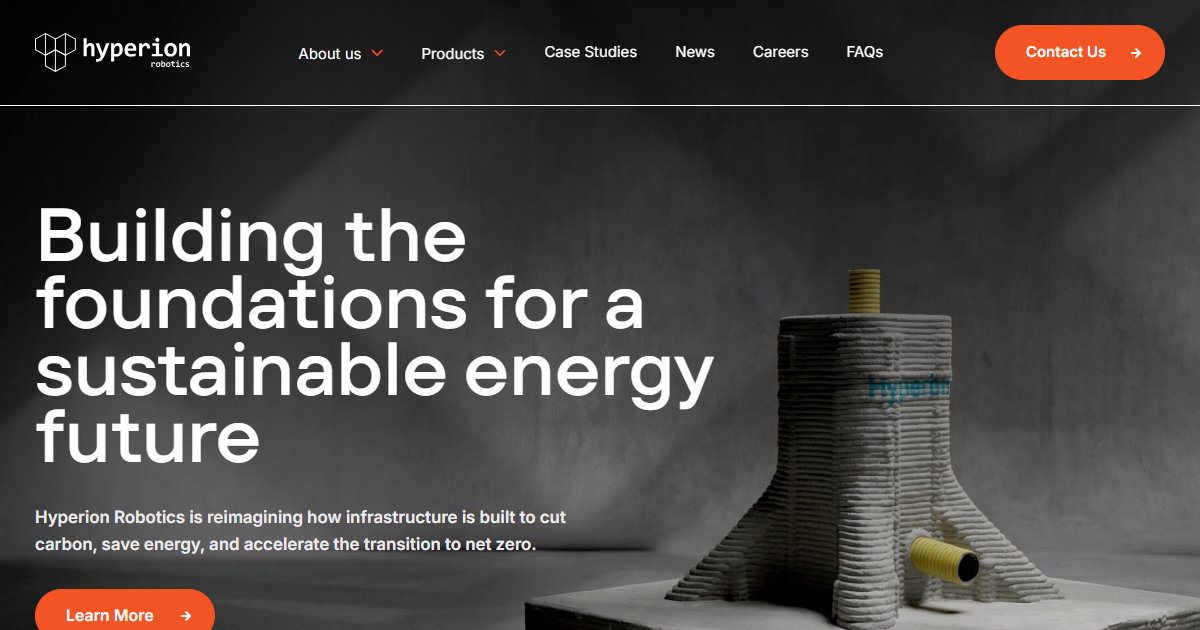
Hyperion Robotics
Hyperion Robotics is a construction technology supplier that fabricates low-carbon concrete structures, including large-format 3D-printed formwork and cast elements, for infrastructure owners and contractors in water, energy, and transport projects.

Depending on scope, Hyperion states that its mixes and geometry can reach up to about 75% lower CO? emissions than conventional concrete on suitable jobs (Hyperion Robotics, 2026). The company pairs structural design, concrete material development, and additive manufacturing, then produces units in European facilities for delivery to site.
Water, wastewater, power transmission, and related civil schemes appear in its public case list, from reservoir pad foundations to substation trials. Work is framed around off-site fabrication, lift planning, and installation support rather than selling a shrink-wrapped desktop app.
Design follows Eurocode-aligned structural design assumptions and EN 206 material rules where cited on its site, with ISO 9001, ISO 14001, and ISO 45001 certifications noted for its management systems. Third-party testing and Environmental Product Declaration data are offered when clients need documented carbon and performance evidence.
Engagement typically starts from a product catalogue or bespoke brief, with published lead-time ranges for catalogue versus custom elements after design freeze. Geography and plant capacity influence scheduling; the vendor positions microfactory capacity in Europe to shorten distance to major infrastructure corridors.
Specifications
Pricing
Platforms
Used for
Used by
Tasks
Pros and cons
Pros
- Public case studies cover substations, reservoirs, and wastewater hubs.
- Documented emphasis on embodied carbon reduction and third-party validation options.
- Clear split between catalogue and bespoke lead-time bands on the FAQ page.
Cons
- Not a general-purpose BIM authoring or coordination suite; engagement is project- and product-based.
- Regional production footprint may matter for non-European sites.
- Pricing and throughput require direct sales discussion rather than self-serve checkout.
Key features
Prefabricated concrete systems: Foundations, chambers, drawpits, and related elements produced for crane installation on site.
Large-format 3D printing: Additive production of permanent formwork combined with reinforced concrete placement in the vendor?s process description.
Low-carbon mixes: Material research including EIC-backed work referenced on the corporate site.
DfMA alignment: Elements sized for manufacture and assembly to fit contractor lift and temporary works plans.
Code and standards references: Public materials cite Eurocode and EN 206 alignment for structural and concrete rules.
Certified operations: ISO 9001, ISO 14001, and ISO 45001 listed for quality, environment, and safety management.
Pricing
Project-based manufacturing
Contact sales
Quote-only engagement. Confirm pricing, currency, and delivery terms on hyperionrobotics.com or with sales.
Frequently asked questions
Is Hyperion Robotics a BIM or CAD program?
No. It supplies prefabricated concrete structures and related engineering services using additive and traditional casting methods. Design coordination still happens in your normal BIM and CAD tools; Hyperion delivers manufactured elements to your specification.
What kinds of structures does Hyperion deliver?
Marketing and FAQ copy reference foundations, distribution chambers, split-flow chambers, drawpits, and similar infrastructure elements. Custom or modular layouts are offered against project criteria.
How much carbon reduction does Hyperion claim?
The FAQ states up to about 75% lower CO? emissions compared with conventional concrete for applicable projects, depending on scope and design. Always confirm project-specific calculations with the vendor.
Where does Hyperion manufacture?
The FAQ lists production in Finland and the United Kingdom and describes European delivery. Facility locations and capacity should be confirmed for your region before contract award.
What standards does Hyperion reference?
Public pages cite structural design aligned with Eurocode EN 1990 and EN 1992 and concrete to EN 206, plus the ISO certifications named above. Your engineer should verify local code acceptance.
What lead times does Hyperion publish?
After design freeze, the FAQ gives roughly four to eight weeks for catalogue products and six to ten weeks for bespoke elements, subject to scope and plant load.