Civ Robotics
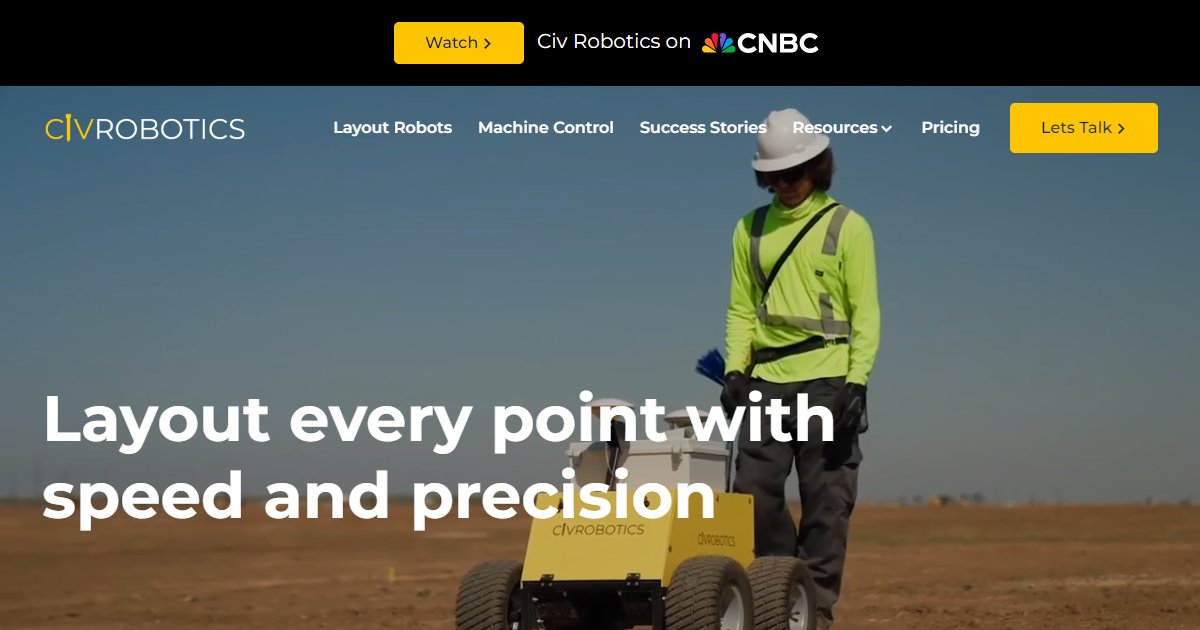
Civ Robotics is a field robotics vendor whose CivDot and CivDot Mini platforms automate construction layout for solar farms and heavy civil jobs by painting or marking thousands of coordinates per day with GPS- and sensor-driven accuracy, while CivNav is positioned for equipment tracking and material distribution planning.

EPCs and contractors use Civ Robotics when manual survey crews cannot keep pace with large, repetitive staking grids, especially on utility-scale solar or linear infrastructure. The products emphasize short training time so general labor can run robots under remote support rather than relying solely on licensed surveyors for every punch.
Marketing pages claim more than twenty gigawatts of solar and renewable projects touched, over ten million field coordinates marked, and deployments across five continents (Civ Robotics, 2026). Those figures describe cumulative marketing reach; validate them during reference checks with teams in your region and technology stack.
Accuracy messaging states roughly three hundredths of a foot (about eight millimetres) precision for CivDot+ and about a tenth of a foot (about thirty millimetres) for CivDot under tilt-compensated staking scenarios described on the site (Civ Robotics, 2026). Productivity comparisons say a traditional crew might lay out two hundred to four hundred fifty points per day while one CivDot operator could mark roughly one thousand to five thousand points per day depending on spacing and tolerance (Civ Robotics, 2026).
Pricing published in 2026 lists CivDot purchases starting near sixty thousand dollars, CivDot Mini near forty thousand dollars, and CivNav rentals near three thousand dollars per month, each with prompts to request a formal quote (Civ Robotics, 2026). Budget for training travel, base station gear, consumables, and software seats beyond the hardware sticker price.
Specifications
Pricing
Platforms
Used for
Used by
Tasks
Pros and cons
Pros
- Targets pain on megaproject sites where staking backlogs delay steel and pile trades.
- Publishes indicative buy and rent prices, which helps internal capex models before you call sales.
- Offers both full-featured and mini hardware tiers for different surface types.
Cons
- Accuracy claims still require independent verification against your control network and spec tolerances.
- Heavy reliance on GNSS means tree canopy, urban canyons, or jamming events need contingency plans.
- Licensed surveyors may still be required to sign legal baselines depending on jurisdiction.
Key features
CivDot layout robot: Automates large coordinate staking campaigns with vendor-stated sub-centimetre-class accuracy on the high-end configuration.
CivDot Mini: Lower-cost line focused on paved-surface line marking for straight or curved runs.
CivNav: Monthly rental option framed around equipment tracking and material distribution optimization.
Operator-friendly workflow: Documentation stresses that prior professional surveying experience is not required for basic operation.
Remote support: Pricing pages mention on-site training paired with remote assistance options.
Pricing
CivNav rental (monthly list)
per month
$3,000.00
Listed near USD 3,000/month on civrobotics.com/pricing as of 2026-04-11; confirm terms.
CivDot Mini (list price)
$40,000.00
Listed near USD 40,000 on civrobotics.com/pricing as of 2026-04-11; confirm with formal quote.
CivDot (list price)
$60,000.00
Listed near USD 60,000 on civrobotics.com/pricing as of 2026-04-11; confirm with formal quote.
Frequently asked questions
What is CivDot used for?
CivDot robots drive the layout of thousands of field points such as pile or post positions on solar sites or other coordinate-heavy civil scopes. The vendor compares daily throughput to traditional survey crews and cites higher points per day for a single operator (Civ Robotics, 2026).
Do I need a licensed surveyor to run CivDot?
Civ Robotics markets the system as operable without prior surveying experience, but legal responsibility for boundary control and record drawings still follows local regulations. Many owners require a surveyor of record to validate control before mass production layout.
How accurate is CivDot?
Product copy lists about eight millimetre-class accuracy for CivDot+ and about thirty millimetres for CivDot under described tilt-compensated modes (Civ Robotics, 2026). Run side-by-side checks with your total station baselines before you accept pay quantities.
How much does CivDot cost?
The pricing page lists CivDot purchases around sixty thousand dollars and CivDot Mini around forty thousand dollars with invitations to request formal quotes (Civ Robotics, 2026). Expect add-ons for training, support tiers, and accessories.
What is CivNav?
CivNav is marketed as a rental-oriented module for about three thousand dollars per month to optimize material distribution and track heavy equipment usage (Civ Robotics, 2026). Confirm telemetry integrations with your fleet telematics stack.
Does Civ Robotics work outside solar?
Messaging highlights solar and infrastructure, but the underlying layout problem appears on any large coordinate grid. Ask for references in your asset class and soil conditions.
Tutorials and learning
Sources
Other Surveying tools
- FARO Focus by FAROEnterprise quote
FARO Focus is a terrestrial laser scanning line that captures 3D point clouds for as-built documentation and BIM-related workflows,
- Leica BLK360 by Leica GeosystemsEnterprise quote
Leica BLK360 is a compact imaging laser scanner that captures spherical imagery and 3D point clouds for documentation and scan-to-BIM
- NavVisEnterprise quote
NavVis is a mobile mapping and digital twin platform that combines SLAM-based wearable and handheld laser scanners with the NavVis IVION web
- Pix4DSubscription
Pix4D is a photogrammetry and drone mapping software family that turns RGB, thermal, or multispectral imagery into survey-oriented point
- Virtual SurveyorFreemium
Virtual Surveyor is desktop drone-surveying software that turns orthomosaics, elevation models, and point clouds into CAD-ready linework,
- 3DF ZephyrFreemium
3DF Zephyr is photogrammetry and reality capture software that creates 3D models, point clouds, orthophotos, DEMs, and survey outputs from
- 4M AnalyticsEnterprise quote
4M Analytics is a Utility AI mapping platform that pulls together public utility records, AI-assisted detections, and human review into one
Agisoft Metashape is photogrammetry software that processes digital images into 3D spatial data such as dense point clouds, textured meshes,