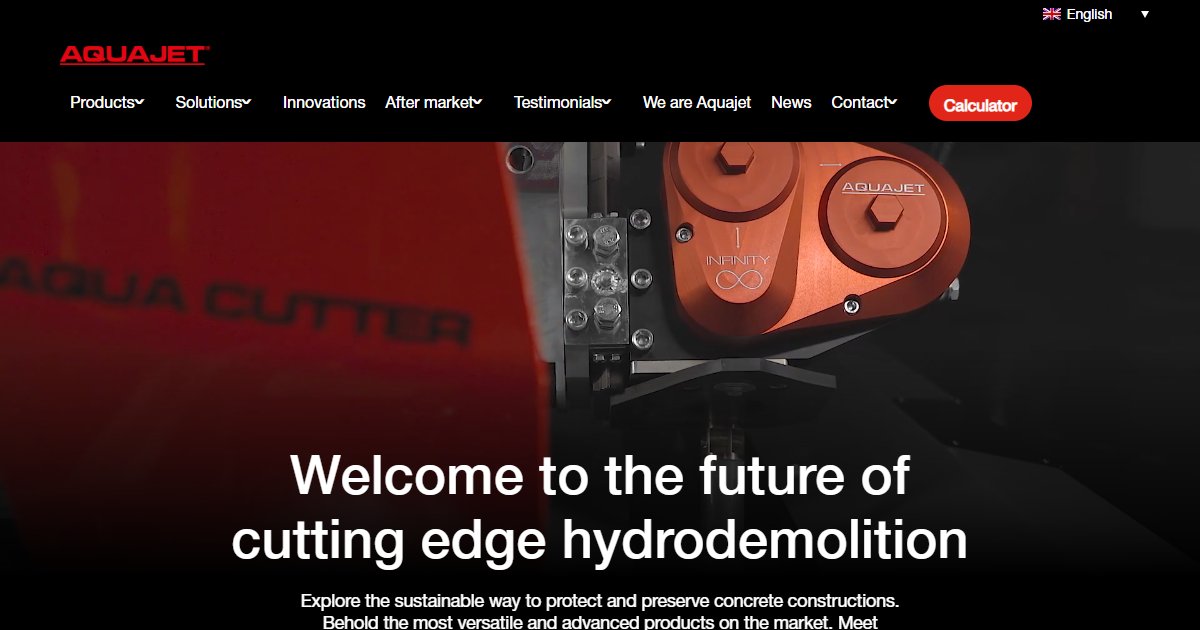
Aquajet
Pricing is tailored to your team. Reach out to the vendor for a quote. See full pricing · Updated May 12, 2026
Aquajet is a hydrodemolition equipment line that uses high-pressure water jets and carrier robots to remove concrete selectively on bridges, tunnels, and industrial structures while preserving rebar.

Aquajet AB, based in Sweden, designs hydrodemolition pumps, robotic carriers, and water-treatment add-ons for contractors who must strip damaged or contaminated concrete without microcracking sound substrate. The method replaces handheld breakers on many jobs by eroding concrete with pressurized water directed through robotic arms (Aquajet, 2026).
Product families span diesel and electric pump units plus tracked or modular robots such as the Aqua Cutter range for vertical, overhead, and confined work. Marketing materials emphasize adjustable impact angles, remote operation for crew safety, and productivity on large deck or tunnel repairs compared with manual demo.
Supporting gear includes wastewater recycling systems so sites can manage slurry instead of releasing it untreated. The firm publishes a periodic product catalogue and appears at concrete and infrastructure trade events such as World of Concrete (Aquajet, 2026).
Customers include specialist contractors and rental fleets serving infrastructure owners; case studies quote faster acceptance after operators see robotic precision versus traditional methods on demanding removals (Aquajet, 2026).
Specifications
Pricing
Platforms
Used for
Used by
Tasks
Pros and cons
Pros
- Selective removal limits damage to sound concrete and steel
- Robots keep operators away from the immediate danger zone
- Electric and diesel options for indoor or outdoor rules
- Established catalog and global distributor footprint
Cons
- Requires water supply, pumping, and often wastewater handling
- Higher equipment cost than handheld breakers for small patches
- Productivity depends on geometry, access, and pump sizing
- Noise and logistics differ from dry methods; plan staging
Key features
Hydrodemolition pumps: High-pressure units sized for different flow and pressure needs on site.
Aqua Cutter robots: Remote-controlled carriers that guide jets across decks, walls, and ceilings.
Water treatment: Optional systems to handle slurry from hydrodemolition in sensitive environments.
Product catalogue: Printed and online catalog for comparing robot and pump configurations.
Training and support: Dealer network for commissioning, parts, and operator guidance.
Pricing
Equipment purchase or lease
Contact sales
Pricing is quote-based through dealers. Request a proposal for pump, robot, and accessory bundles.
Prices come from each vendor’s public listings and can change. Double-check the current price on the vendor site before you buy.
Frequently asked questions
What is hydrodemolition?
Hydrodemolition uses ultra-high-pressure water jets to break concrete without impacting rebar the same way impact tools can. Aquajet couples pumps with robotic arms to automate the pattern and depth of removal.
Is Aquajet only for horizontal decks?
The lineup includes robots aimed at walls, ceilings, and complex profiles, not only bridge decks. Model guides describe maximum reach and mounting options for different faces.
Does Aquajet sell pumps without robots?
Yes. The catalog lists hydrodemolition pumps as a category separate from robots so teams can match power units to existing carriers or job constraints.
How do you handle wastewater?
Aquajet markets wastewater treatment systems alongside demolition robots so crews can close the loop on slurry, which matters near waterways or in enclosed spaces.
Where is Aquajet based?
Company materials identify Aquajet as a Swedish supplier with worldwide distribution through partners and trade-show presence.
Aquajet vs handheld breakers for bridge work?
Hydrodemolition trades fuel, water, and pump logistics for predictable depth control and less microcracking on substrate. The better fit depends on spec, access, schedule, and environmental rules on the bridge.
Tutorials and learning
Sources
Other Field & Mobile tools
- ArgylePaid (trial)
Argyle is an augmented-reality field platform from Argyle Build Inc. that aligns federated BIM geometry with real-world jobsites on HoloLens
- Autodesk BuildEnterprise quote
Autodesk Build is cloud construction management on Autodesk Construction Cloud that ties RFIs, submittals, sheets, cost activities, and
- Baubot by fischerEnterprise quote
Baubot by fischer is a mobile jobsite robot that drills, cleans, marks, and sets anchors from a coordinated digital plan, writing execution
- BrokkEnterprise quote
Brokk is a line of remote-controlled demolition robots and power packs used in construction, mining, and industrial plants to break concrete
- BuildotsEnterprise quote
Buildots is construction progress software that turns 360-degree site video, designs, and schedules into measured work-in-place, delay
- Built RoboticsEnterprise quote
Built Robotics is a field robotics vendor focused on utility-scale solar construction, where its RPD and RPS pile-handling and driving
- Canvas Drywall FinishingEnterprise quote
Canvas Drywall Finishing is an on-site construction robotics line that automates sprayed and sanded drywall work so crews can hit repeatable
- CapmoEnterprise quote
Capmo is cloud construction project management software for Germany, Austria, and Switzerland that ties site documentation, plan